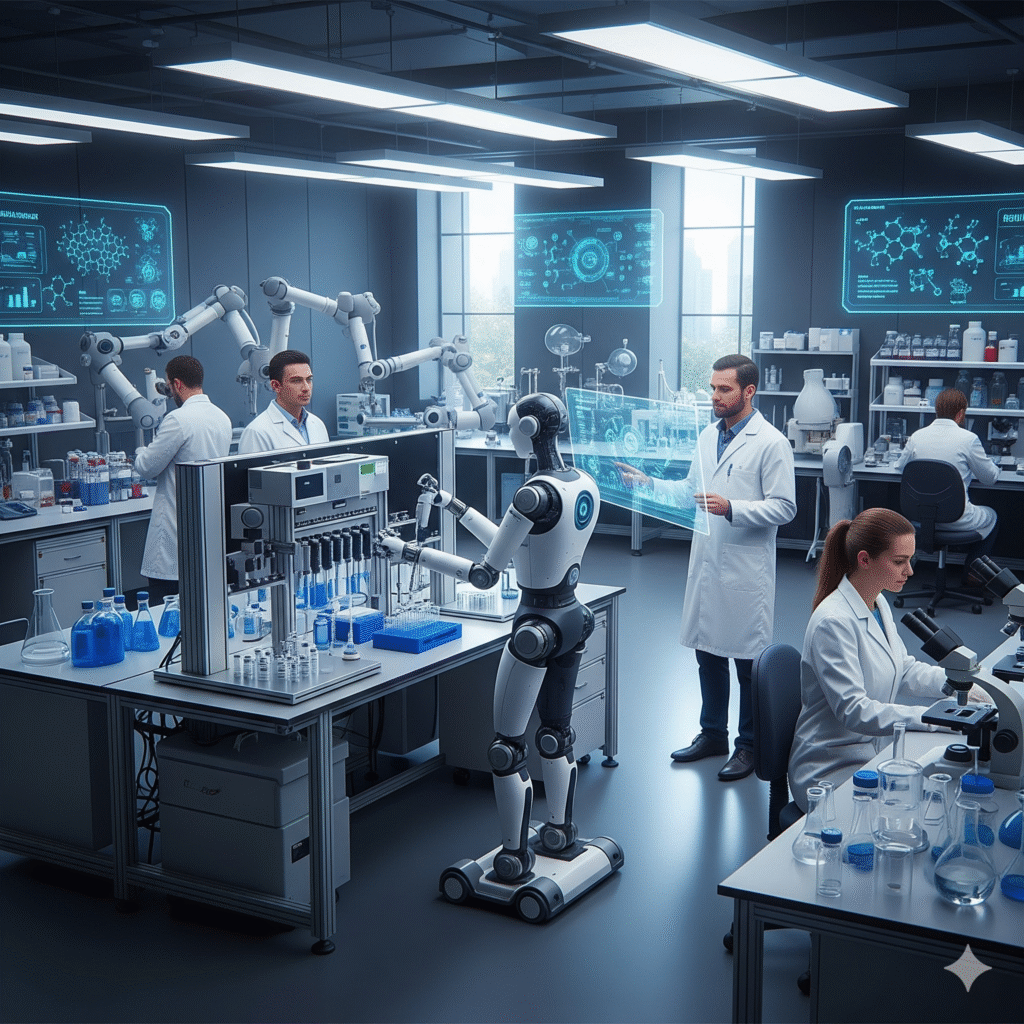
Pharma has never been about innovation, yet innovation is costly, time-consuming, and frequently unpredictable. For generations, the process from molecule discovery to commercial-ready drug has taken 10–15 years and billions of dollars. Yet today, the tide is shifting. Artificial Intelligence (AI), particularly generative AI, is becoming the new R&D laboratory, reducing timelines, reducing costs, and making drug discovery intelligent.
For businesses such as Davyson Healthcare, which are always seeking means of being at the forefront of the global race in pharmaceuticals, AI is no longer an option—it is imperative.
Why AI Is the New Backbone of Pharma R&D
Traditional research models in pharma face bottlenecks:
- Long trial cycles
- High failure rates (more than 90% of drug candidates fail clinical trials)
- Skyrocketing costs in molecule testing and regulatory approvals
Generative AI, however, has changed the game. By leveraging machine learning models, pharma companies can now:
- Predict how molecules interact with human cells
- Optimize compounds virtually (before investing in physical trials)
- Simulate thousands of experiments in seconds
This not only accelerates R&D but also reduces wasted resources, making healthcare more efficient and accessible.
The Role of Generative AI in Pharma
Generative AI doesn’t just analyze existing data—it creates new possibilities. Here’s how it’s transforming pharma:
1. Drug Discovery
AI can design entirely new drug candidates by predicting their structure, properties, and effectiveness. This reduces years of trial-and-error into months of simulation.
2. Precision Medicine
Generative models help create personalized treatment plans, predicting how specific patient groups will respond to therapies.
3. Clinical Trial Optimization
AI identifies the best trial participants, reducing dropout rates and improving trial outcomes.
4. Manufacturing Efficiency
AI is used in predictive maintenance of pharma machinery, supply chain optimization, and quality assurance.
For companies like Davyson Healthcare, this means faster go-to-market timelines, lower R&D costs, and higher trust among patients and regulators.
Case Study Snapshot: AI vs Traditional R&D
Here’s a comparative view of how AI-enabled R&D stacks up against the traditional model:
| Parameter | Traditional R&D | AI-Powered R&D (Generative Tech) |
| Time to identify drug candidate | 5–6 years | 6–12 months |
| Cost (average) | $2–3 billion | $500 million – $1 billion |
| Trial success rate | <10% | 20–30% (projected) |
| Scalability | Limited | High (can run multiple simulations at once) |
| Data usage | Clinical and lab-based | Multi-source (genomics, proteomics, patient data) |
Insight: AI doesn’t just save time and money; it increases the probability of success in a field where failure is the norm.
How Davyson Healthcare Is Adapting to the AI Revolution
Pharma leaders understand that the future belongs to data-driven innovation. Davyson Healthcare is at the forefront of integrating AI into its R&D ecosystem.
Here are some of the key ways Davyson Healthcare leverages AI:
- Molecule Design & Screening: Using generative AI to design compounds with higher accuracy.
- AI in Clinical Trials: Identifying patient cohorts and predicting responses.
- Supply Chain Optimization: Leveraging AI to ensure timely and cost-effective delivery of drugs.
- Regulatory Compliance Automation: Automating documentation to meet FDA and global regulatory standards.
This not only positions Davyson Healthcare as a trusted name in pharma innovation but also ensures it stays competitive in the global marketplace.
Challenges in AI Adoption for Pharma
Of course, it’s not all smooth sailing. Integrating AI into pharma comes with challenges:
- Data Privacy Concerns: Patient data security is critical.
- Regulatory Uncertainty: Regulators are still adapting to AI-led drug development.
- High Implementation Costs: Building AI infrastructure requires upfront investment.
- Talent Gap: Pharma needs data scientists as much as it needs medical researchers.
But for vision-driven companies like Davyson Healthcare, these challenges are not roadblocks—they’re stepping stones to leadership.
The Future: AI as a Partner, Not a Replacement
Generative AI is not here to replace scientists but to amplify their capabilities. Human expertise combined with AI precision creates a hybrid innovation model where:
- Researchers get faster insights
- Patients get safer, personalized treatments
- Companies achieve sustainable growth
The pharma of tomorrow will be faster, smarter, and more ethical—and AI will be the invisible partner making it happen.
Key Takeaways for the Pharma Industry
- Generative AI is transforming R&D—cutting costs, reducing failures, and boosting efficiency.
- Davyson Healthcare is leveraging AI to stay ahead in molecule design, clinical trials, and supply chain management.
- Challenges exist, but the benefits far outweigh the risks.
- The future of pharma is AI-human collaboration, not competition.
Conclusion
The pharmaceutical market is on the cusp of an age where the data molecule is the new molecule, and AI is the new lab. For Davyson Healthcare and other companies, this isn’t merely a matter of embracing technology—it’s about driving innovation in healthcare.As technology advances, patients will be able to have safer medicines, quicker cures, and more tailored treatments. And pharma businesses that lead this revolution early on will set the agenda for the future of medicine.In brief, generative AI is not simply educating pharma—it’s rewriting the drug discovery rulebook.
Trending FAQs on Generative AI in Pharma R&D
1. What’s Eroom’s Law, and can AI actually reverse it?
Answer: Eroom’s Law states that drug development is getting slower and costlier over time—untwisting Moore’s Law in reverse. And yep, AI’s the shot-in-the-arm pharma’s been needing to (maybe) reverse that.
2. Which real-world pharma giants are rolling with generative AI—and how?
Answer: Big names—IQVIA, Genentech (Roche), Johnson & Johnson, Merck, Eli Lilly—are all running AI legit: speeding up data review (IQVIA cut 7 weeks to 2), building AI literacy programs, even building proprietary platforms like Merck’s GPTeal.
3. Which companies are actually delivering results right now?
Answer:
- Insitro: pairing ML with Big Pharma (Eli Lilly, BMS) to accelerate discovery.
- Exscientia: AI-matched therapies showed a 54% better control in certain advanced-cancer cases.
- Insilico Medicine: AI-found drug in 46 days, mid-stage human trial underway.
Plus, MIT’s Jameel Clinic turned deep learning loose and discovered a groundbreaking antibiotic, halicin, in 2020 — first new in decades.
4. What are the game-breaking benefits of generative AI in pharma?
Answer: Faster drug design, lower costs, more novel compounds, higher precision, less wasted resources. Early work shows virtual screening, molecule generation, even trial simulations are speeding up discovery.
5. So what’s holding pharma back from going full-AI?
Answer:
- Data drama: You need massive, clean, reliable datasets.
- Opaque models: AI’s “black box” nature raises trust issues.
- Regulatory lag: FDA/EMA frameworks are still catching up.
- Ethical worries: Bias, privacy, patient consent—these are massive.
- IP mess: Who owns an AI-designed molecule, anyway?
6. How’s pharma workforce keeping pace with AI?
Answer: Massive upskilling is in motion—J&J mandatory AI training for 56,000 staff, Merck built its own AI platform, Lilly wants AI fluency baked into leadership.
7. What’s next—for real future-proofing?
Answer:
- Hybrid AI-human workflows: AI pitches candidates; humans sign off.
- Better synthetic data & Retrieval-Augmented Generation (RAG): Keeps models current.
- Ethics baked in: transparency, bias mitigation, patient-first standards.
- Experimental coupling: AI marrying with HTS (high-throughput screening) and real-world validation to close feedback loops